Sheffield Wednesday takeover ends administration, but spending limits remain
La reprise de Sheffield Wednesday par Arise Capital Partners sort le club de l’administration et l’EFL renonce à la pénalité de 15 points, sous conditions. Mais un budget limité sur deux saisons encadre encore le recrutement et l’investissement.

Sheffield Wednesday’s takeover has been completed by the US-led consortium headed by David Storch through Arise Capital Partners. The deal takes the club out of administration, while the additional 15-point League One deduction has been waived subject to compliance with an agreed business plan. For supporters, the distinction matters: ownership uncertainty has ended, but financial restrictions have not.
Sheffield Wednesday’s new owners and what has changed
BBC Sport’s takeover coverage identifies David Storch as the consortium leader, alongside Michael Storch and Tom Costin. Arise Capital Partners is the investment vehicle behind the acquisition. The completed sale marks the departure of former owner Dejphon Chansiri and allows Wednesday to exit administration.
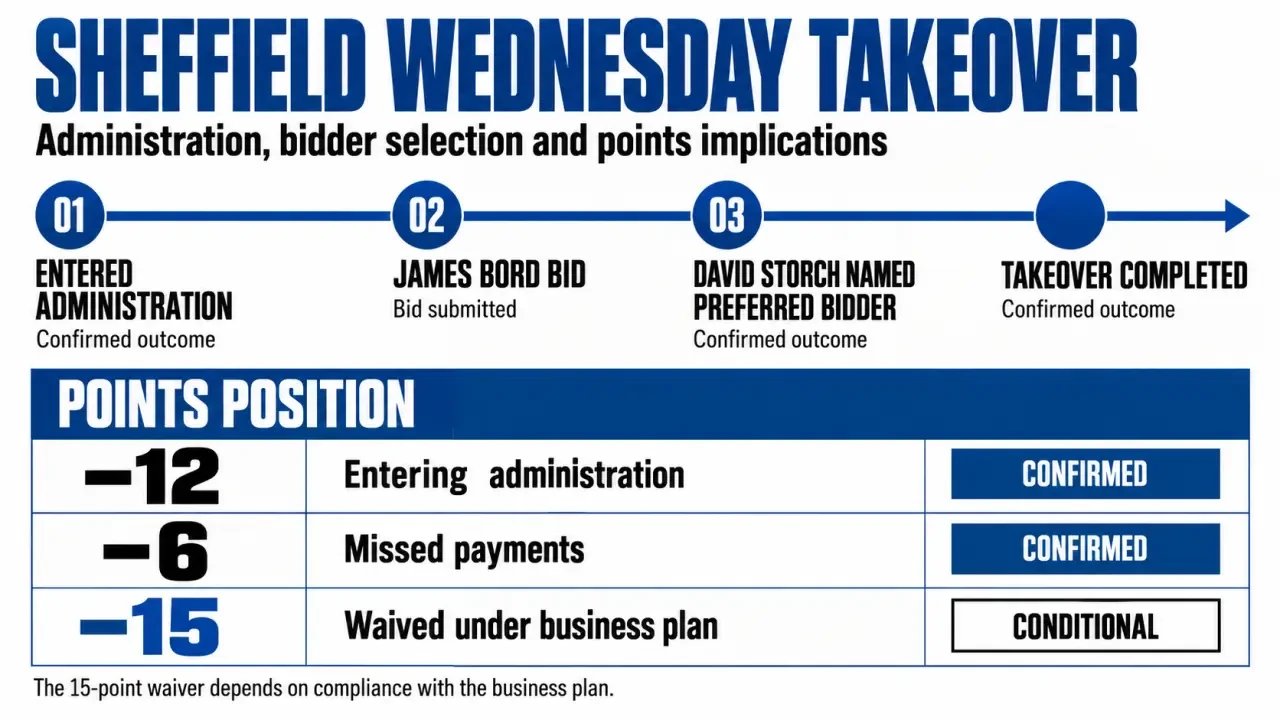
Those are separate milestones with connected consequences. A change of owner establishes who controls the club; leaving administration resolves the insolvency process. Neither, by itself, means unrestricted spending or an immediate sporting recovery.
The immediate position is therefore clearer than the longer-term outlook. Wednesday have new ownership and a framework for operating outside administration. The next test is whether that framework supports a sustainable squad rebuild and investment in the ground without creating fresh financial instability.
The 15-point deduction decision is conditional
As Sky Sports explains in its report on the EFL decision, insolvency rules normally require creditors to receive at least 25p in the pound. That means repayment of 25 per cent of the money owed. Failure to satisfy the relevant requirements can bring an additional 15-point sanction.
The EFL board has discretion in exceptional circumstances. In Wednesday’s case, the decision not to impose that additional handicap is tied to an agreed business plan. It should not be read as an unconditional removal of financial oversight.
The distinction between that sanction and the penalties already incurred is important:
| Penalty | Reason | Relationship to the takeover |
|---|---|---|
| 12 points | Entering administration | An earlier sporting penalty, not the additional sanction addressed by the takeover agreement. |
| 6 points | Missed payments | A separate penalty, bringing the earlier deductions to 18 points. |
| 15 points | Insolvency exit requirements | The additional League One sanction waived subject to business-plan compliance. |
The Athletic’s account describes the creditor dispute surrounding Chansiri’s position and his reported £60 million in loans to the club. That repayment issue helps explain why completing a purchase and satisfying insolvency requirements were not simply the same transaction.
From the James Bord bid to the Storch agreement
The sale was not a straightforward handover between two owners. Begbies Traynor administered the insolvency and sale process, which included an unsuccessful attempt by a consortium led by James Bord before Storch’s group secured the club.
The Athletic reports a £47.8 million agreement associated with the Bord bid and approximately £4 million spent by that consortium on day-to-day running costs. Storch subsequently became preferred bidder under a reported £20 million agreement. These reported figures should not be treated as directly comparable valuations without the full contractual terms.
- Administration: the club entered an insolvency process under Begbies Traynor.
- Bord’s unsuccessful bid: the proposed takeover collapsed, leaving ownership unresolved.
- Storch’s preferred-bidder agreement: negotiations proceeded with the Arise Capital Partners consortium.
- Completion: the new ownership took control and Wednesday exited administration.
Preferred-bidder status was a negotiating milestone, not proof that a sale had finished. Completion is the decisive difference between the earlier uncertainty and the ownership position now reported.
League One recruitment remains within a two-season budget restriction
The takeover does not reverse relegation to League One. Its immediate sporting benefit is the avoidance of the additional 15-point handicap, rather than restoration of Wednesday’s previous divisional position.
According to Sky Sports, the club remains under a budget restriction for two seasons. Player registrations are permitted within the business plan. Supporters should therefore distinguish between a recruitment ban and controlled recruitment: Wednesday can sign players, but must do so within the agreed terms.
That makes the balance of the rebuild important. Transfer announcements alone cannot show whether a squad is affordable. The useful questions are whether recruitment fits the permitted budget, addresses weaknesses and leaves enough room for the club’s other obligations. The agreement is a framework for rebuilding, not permission to spend without limits.
Hillsborough investment and the test of lasting stability
The Athletic reports £10 million in planned stadium investment. That is a significant commitment, but planned spending should remain distinct from work completed. Supporters will be able to judge delivery through specific projects and subsequent reporting, rather than the takeover announcement alone.
There is a pendulum risk after a football financial crisis: understandable relief can swing into demands for immediate spending, before disappointment pushes expectations back towards alarm. A steadier measure is to assess recruitment, running costs and stadium work together. Money committed to one purpose cannot automatically be counted again towards another. That makes a balanced programme more useful than a single eye-catching pledge.
Wednesday’s recovery now depends on execution. The new owners have ended the administration chapter and secured relief from an additional sporting sanction. Maintaining that progress means meeting the business plan, rebuilding the squad and turning infrastructure commitments into visible improvements. For supporters, those are the practical measures of whether a completed takeover becomes lasting stability.